Understanding a Crane Load Chart: A Guide for Construction Professionals in Thailand
Homepage > News > Crane Knowledge > Understanding a Crane Load Chart: A Guide for Construction Professionals in Thailand
Key Highlights: A crane load chart is the manufacturer’s specification for a mobile crane’s maximum safe lifting capacity. The capacities change depending on boom length, working radius, and crane configuration. Knowing how to read a load chart, apply the net capacity formula, and recognise the safety thresholds that govern critical lifts is crucial for any project manager, site supervisor, or crane operator working in Thailand’s construction and industrial sectors. This guide covers every component of a mobile crane load chart.
A crane load chart is one of the most important safety documents in any lifting operation. Understanding a load chart is crucial for project managers, site supervisors, and procurement teams to avoid overloading and ensure safe operations.
This guide helps you read a crane load chart and apply the mobile crane load calculation formula correctly.
What Is a Crane Load Chart?
A crane load chart is the manufacturer’s specification for a crane’s maximum safe lifting capacity under defined operating conditions. It is built on core engineering parameters: structural strength, hydraulic performance, and stability design.
A load chart does not give you a single number. Crane capacity is a dynamic variable. It changes depending on boom length, working radius, boom angle, counterweight configuration, and outrigger deployment. For example, a crane with a maximum gross capacity of 100 tonnes may only be rated for 15–20 tonnes at a 15-metre working radius with its boom fully extended.
Each crane model comes with a unique load chart, and a crane can have several charts for various configurations. Using an incorrect chart for a crane model or applying a full-outrigger chart to partial outriggers is a dangerous mistake that has led to accidents.
Every operator, rigging supervisor, and site foreman involved in planning or overseeing a lift must be able to locate, identify, and correctly read the chart that applies to their specific configuration.
Key Factors of a Mobile Crane Load Chart
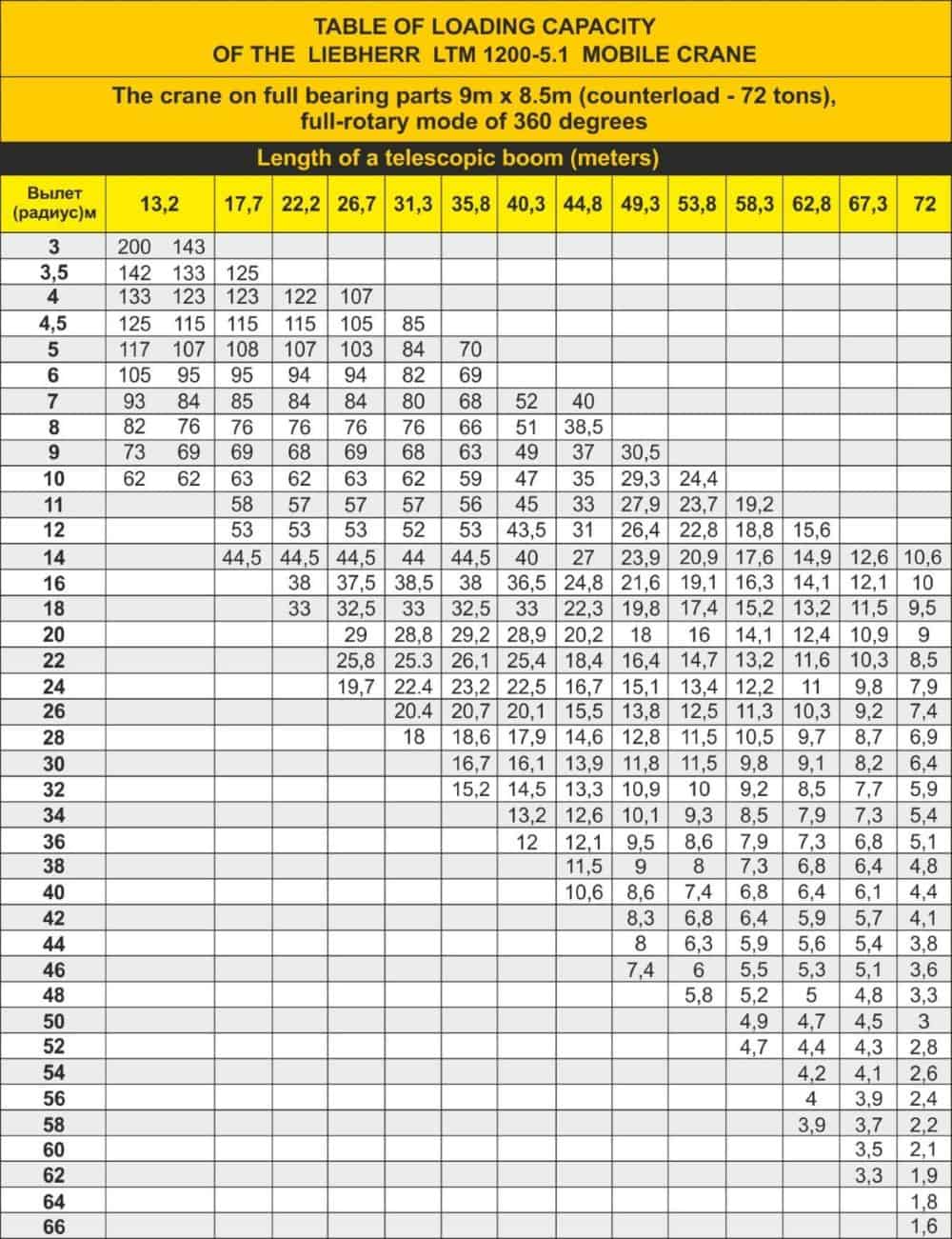
A standard mobile crane load chart contains several data sets that affect each other. The table below covers the key components:
Factor
Definition
Working radius (lifting radius)
Horizontal distance from the crane’s centre pin (slew axis) to the centre of the load
Boom length
The extended length of the crane’s boom is typically listed as column headers across the top of the chart
Boom angle
The elevation angle of the boom above the horizontal, which determines height and directly affects the radius
Rated capacity (gross)
The maximum load in tonnes at the intersection of a given boom length and working radius (before rigging deductions)
Counterweight configuration
The specific counterweight arrangement the chart applies to (charts for different counterweight loads are separate)
Outrigger deployment state
Whether outriggers are fully extended, partially extended, or retracted. This changes capacity significantly
The bold line or dashed boundary
Divides values governed by structural limits (above the line) from values governed by stability limits (below the line)
The inverse relationship between working radius and capacity governs the entire chart.
As the load moves further from the crane’s centre pin, the rated capacity falls, and this value could change significantly. The longer the arm, the greater the overturning moment it creates. Counterweights exist to offset this moment, but they have limits.
The bold boundary line that may sometimes appear on load charts shows two thresholds: values above this line are limited by the crane’s structural strength. Values below it are limited by stability (or the crane’s resistance to tipping). Both sets of limits are absolute and should not be exceeded.
The Mobile Crane Load Calculation Formula
Once you have located the gross rated capacity on your mobile crane load chart, apply the mobile crane load calculation formula to convert it into a usable net lifting capacity:
Net Lifting Capacity = Gross Rated Capacity (from chart) − Total Rigging Deductions
Rigging deductions are the combined weight of all equipment attached to the hook that is not the load itself. These include:
Hook block: The pulley block assembly through which the hoist line passes
Wire rope slings or chain slings: The connecting hardware between hook and load
Spreader bars or lifting beams: Used when the load requires distributed attachment points
Shackles and other rigging hardware: Every item attached to the hook line contributes to the total deduction
As a practical example: if the load chart shows a gross rated capacity of 50 tonnes at your working radius and boom length, and your rigging assembly totals 2.3 tonnes (hook block 0.8t + slings 1.5t), your net lifting capacity is 47.7 tonnes. Your actual load must not exceed this figure, and responsible practice keeps a meaningful safety margin below it.
Never plan to operate at 100% of the net rated capacity. Industry standards define any lift exceeding 75% of the crane’s rated chart capacity as a critical lift (requires a documented lift plan, formal hazard assessment, and pre-lift briefing before work begins). The 75% threshold exists because of real-world conditions, such as wind, ground movement, and load swing, which introduce variables the chart cannot account for.
How to Read Your Crane Load Chart Step by Step
Caption: Crane operator and site foreman reviewing a range diagram and load chart together before a scheduled lift at an industrial facility in Rayong. Image Alt Tag: Crane operator and site foreman reviewing crane load chart range diagram before industrial lift in Rayong Thailand.
Follow this sequence before every lift.
Identify your working radius: Measure the horizontal distance from the crane’s centre pin (slew axis) to the centre of gravity of the load. This is your operating radius and is the primary variable used to locate your position on the chart.
Determine the required boom length and angle: Based on the height the load must reach and the horizontal distance to the placement point, calculate the minimum boom length and angle needed. The range diagram supplied alongside the load chart provides a visual guide to boom reach, height, and angle relationships.
Confirm your crane configuration: Before reading any capacity figure from the chart, confirm that the configuration on site matches the chart’s stated parameters. Check: counterweight installed (mass and position), outrigger extension state (fully extended, 50%, or retracted), and whether any jib or fly extension is deployed. If the configuration does not match, the chart’s figures do not apply.
Locate the intersection on the chart: Find the column corresponding to your boom length and the row corresponding to your working radius. The value at their intersection is the gross rated capacity for that specific configuration.
Calculate net lifting capacity: Subtract all rigging deductions (hook block, slings, spreader bars, and all attached hardware) from the gross rated capacity. The result is the maximum weight of payload you may safely lift.
Verify the actual load weight and apply a safety margin: Confirm the load’s weight from engineering drawings, material certificates, or weighing. Compare this against your net capacity. For routine lifts, maintain a minimum 25% safety margin below rated net capacity. For any lift exceeding 75% of rated capacity, initiate critical lift procedures.
Safety Considerations When Using Load Charts
A load chart defines maximum capacities under ideal conditions: level ground, calm weather, correct configuration, and verified load weights. Real construction sites in Thailand rarely offer all of these at once. Each of these factors can reduce effective capacity below the chart figure.
Wind Conditions
Wind applies additional lateral forces on both the crane structure and the suspended load. OSHA does not set a fixed wind speed limit. However, under 29 CFR 1926.1417, a competent person must adjust operations for wind. The manufacturer’s operator manual is the authoritative source for each crane’s wind thresholds.
As a general industry reference, most mobile crane operators begin assessing load and configuration at around 20–25 mph (32–40 km/h) and suspend operations as real conditions approach or exceed that range. This is important, especially during Thailand’s monsoon season, when wind on construction sites may affect construction safety.
Ground Conditions and Site Slope
All outrigger-based load chart values assume level, firm, and stable ground with a slope no greater than 1 degree. A slope of 3 degrees can shift the crane’s centre of gravity sufficiently to reduce effective capacity by 15–20% compared to the chart value. Before positioning any mobile crane, the ground-bearing capacity must be assessed and, where required, outrigger mats or steel pads deployed to distribute the load. Sites with recently filled ground, drainage channels, or underground utilities require special attention.
The 75% Rule for Critical Lifts
As noted above, any lift exceeding 75% of the crane’s rated chart capacity is classified as a critical lift. This classification triggers a higher standard of planning: a written lift plan must be prepared by a qualified person, all relevant personnel must be briefed, and the lift must be reviewed and approved before execution.
Using the Correct Chart for Your Specific Crane
Load charts are specific to a crane’s serial number and exact configuration. Two cranes of the same model but different production years may have different rated capacities. A chart prepared for a crane with a full counterweight must never be applied to one with a partial counterweight. Always verify the chart corresponds to the specific crane and configuration being used.
When to Consult a Professional Crane Service
For lifts near power lines, over occupied structures or active roadways, involving multiple cranes, or at the upper range of rated capacity, the planning and execution should involve an experienced crane service provider from the outset. Professional crane rental companies with strong safety records offer technical expertise to verify that every chart parameter is met before the lift begins.
Trust EK Crane’s Expert Teams for Safe Mobile Crane Operations
In Bangkok, Rayong, and the EEC zone, where ground conditions, sequencing, and safety obligations leave no room for estimation, responsible crane service operators who apply load chart discipline correctly can prevent an unwanted accident.
EK Crane provides mobile crane rental with an experienced team who will help you choose the best crane suitable for your project. Our renting service provides both daily and monthly rentals for every area in Thailand. For more information on mobile crane rental price, contact LINE: @EKCRANE or reach us via the contact information below.
A crane load chart is the manufacturer’s specification for a crane’s maximum safe lifting capacity under defined operating conditions. It is presented as a grid with working radius on one axis and boom length on the other so operators can read the gross rated capacity for any given configuration. A single crane will have multiple charts to cover different outrigger positions, counterweight arrangements, and boom extensions.
2) How do you calculate mobile crane lifting capacity?
Locate the gross rated capacity on the load chart at your working radius and boom length. Then subtract all rigging deductions: hook block, slings, spreader bars, and any attached hardware. The result is the net lifting capacity, which is the maximum payload weight you may safely lift.
3) What is the 75% rule in crane operations?
Any lift exceeding 75% of the crane’s gross rated chart capacity is classified as a critical lift under OSHA standards. It requires a written lift plan, a pre-lift crew briefing, and review by a qualified person before work begins. The threshold exists because wind, ground movement, and load swing can reduce effective capacity below what the chart shows under ideal conditions.
4) What factors reduce a mobile crane’s safe lifting capacity below the load chart figure?
Load charts assume still air, level ground, and the exact configuration stated on the chart. Wind adds lateral forces the chart does not account for. A ground slope beyond 1 degree shifts the crane’s centre of gravity and reduces stability. Soft ground under outriggers compromises the rated support area. Using a configuration that differs from the chart, such as partial outrigger extension or reduced counterweight, can also invalidate the chart figures entirely.